
How Will We Live?
An Excerpt from Becoming Neighbors
What does it look like to pursue the common good as a daily, local practice?
That's the question at the heart of Becoming Neighbors, the debut book from theologian and public scholar Amar D. Peterman, who also happens to be one of our Residents in Place, rooted in Bluemound Heights, Milwaukee.
It's a book for anyone who's ever wondered what the church could look like if it took its own neighborhood seriously. We're grateful it exists, and we're glad to share a piece of it with you.
How Will We Live?
Can you imagine a world where we become neighbors to one another? Amid our struggles and divisions, can you envision a shared, communal table where people are joined together across their differences? Can you close your eyes and picture who might be sitting to your left and right? Whose presence makes your heart skip a beat? What dishes do you smell? What languages do you hear? What will you contribute?
This book is about the pursuit of the common good through a faith formed by and toward love of neighbor. It has in mind what and who we will be to each other in this cultural moment and in the moments to come. At the heart of this work is a simple but critical question: How will we live?
The Common Good Is Local
Cultivating this shared vision of the common good is a deeply local task. The key to shared flourishing for our neighborhoods is not located beyond the stars—if only we could build ideological spaceships to capture it. Instead, communities thrive when we turn our gaze horizontally toward our neighbors and the world around us. Contained in every person is an endless galaxy of beliefs and experiences, of joys and sorrows, of fears and comforts. Any meaningful pursuit of a common good will require us to know our neighbors.
What will draw Christians toward common action toward the common good, though, is not only shared belief; it is also shared desire. We must become a people whose faith and desire are nurtured, formed, and cultivated by love for our neighbors. When we join with others in this common life, we are drawn into the vast expanse of their infinity just as they are drawn into ours. This neighbor-loving work not only changes what we believe about our neighbors; it also transforms how we relate to them. They are no longer enemies to fight; they are people to love. They are no longer social media handles or digital avatars; they are complex humans who are motivated by their deep values and their felt vulnerabilities. If we seek the shared flourishing of our community, we must desire right relationship with our neighbors.
The Table
Seeking the common good through this local practice of neighbor love is messy and complicated work. It would be far easier to remain aloof and simply read about our “neighbors” in books and surveys or make assumptions about them based on their yard signs. However, cultivating a truly common good requires humble proximity where our beliefs and assumptions about one another are challenged by the lived experiences of our neighbors. Our shared flourishing is impossible unless we enter into a common life where we are formed by and toward one another. Throughout this book, I use a simple illustration to describe this space: the table.
The table where the common good is cultivated recognizes and honors the goodness of all who are seated around it. At the table, people of different faiths, cultures, traditions, and beliefs are valued as partners in the work of loving and joining. Shared flourishing is not a zero-sum game, and we are not competitors. As neighbors, we come bearing our community’s best “dishes,” eager to share our wisdom, liturgies, and practices with others. It is marked by a desire for conversation, not conversion, for shared action, not stubborn arguments. The table also reminds us that goodness is not hidden behind a locked church door. Our God is too generous to reserve goodness for any one people or keep it stored in one place. Our pursuit of the common good must recognize and honor the goodness present in those outside our tradition. We must acknowledge that this work of cultivating a common good has long been happening outside the church. At the table, we cannot eat only what we brought. Our plates must be filled with our neighbors’ dishes as well.
“We cannot eat only what we brought.”
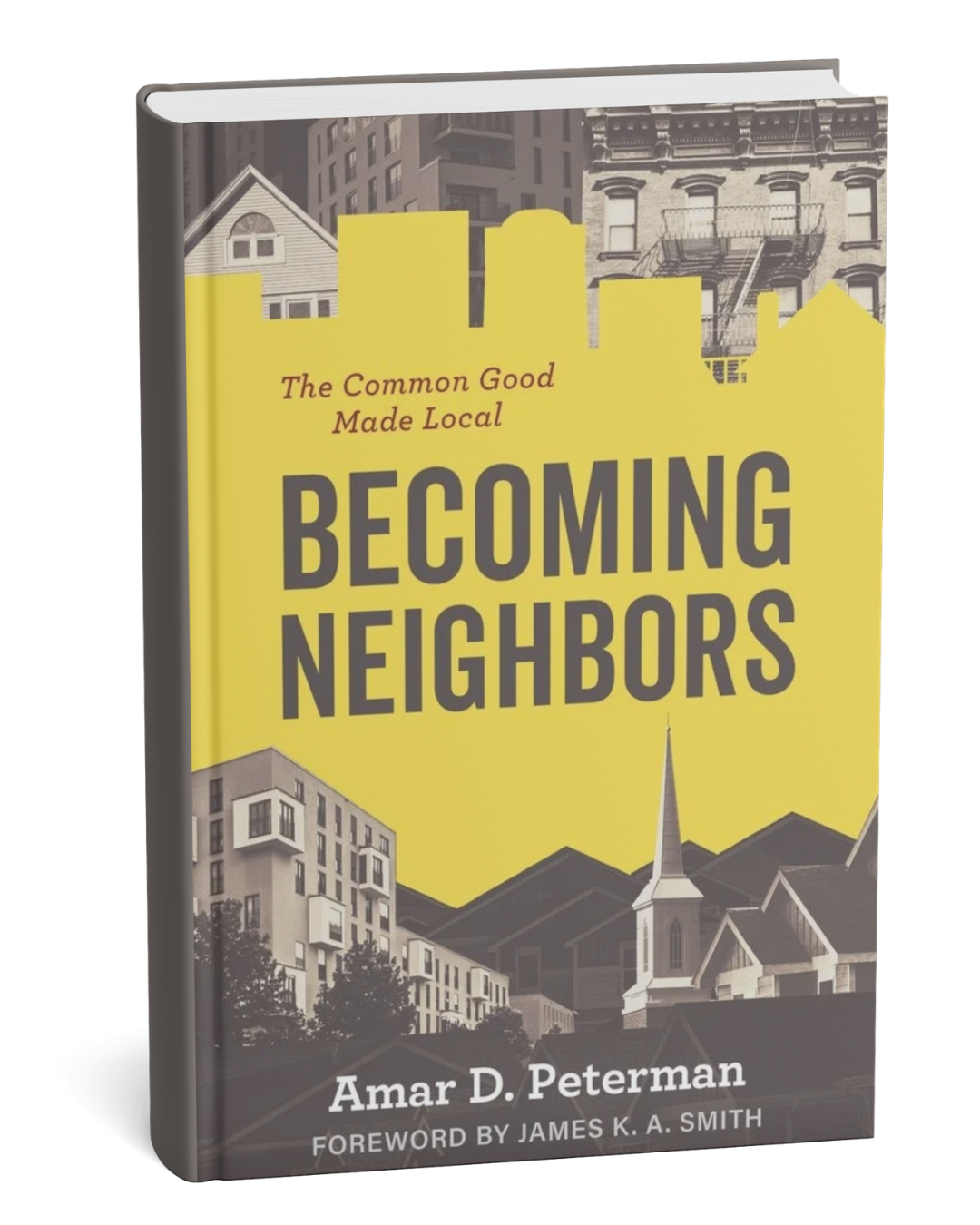
— Amar D. Peterman, Becoming Neighbors
(Eerdmans, 2026; shared with permission)
Reflection
Amar's whole book turns on one deceptively simple question: How will we live?
Not in theory. Not out beyond the stars, as he puts it — but here, on your actual block, with the actual people whose names you may or may not know.
It's easy to love “neighbors" in the abstract. It's harder, and far more transforming, to sit at a table across from one.
Who lives near you that you've quietly filed away as a category rather than a person?
What might it take to move close enough that your own assumptions get challenged — not by an argument, but by their actual life?
Next Step
Amar writes that at the table, "we cannot eat only what we brought." Neighboring means showing up hungry for what someone else carries. Start there:
➤ Notice one neighbor you tend to keep at a distance and get curious about their story instead of your assumptions.
➤ Share a table this month. Bring your dish; make room for theirs. Aim for conversation, not conversion.
➤ Ask a question you don't already know the answer to, and stay long enough to really hear the answer.
The common good isn't built beyond the stars. It's built horizontally,
neighbor by neighbor, plate by plate.
